
H E R E D I C A R E
A Preventative Healthcare App
Empowering patients to manage health risks with an AI-driven healthcare app
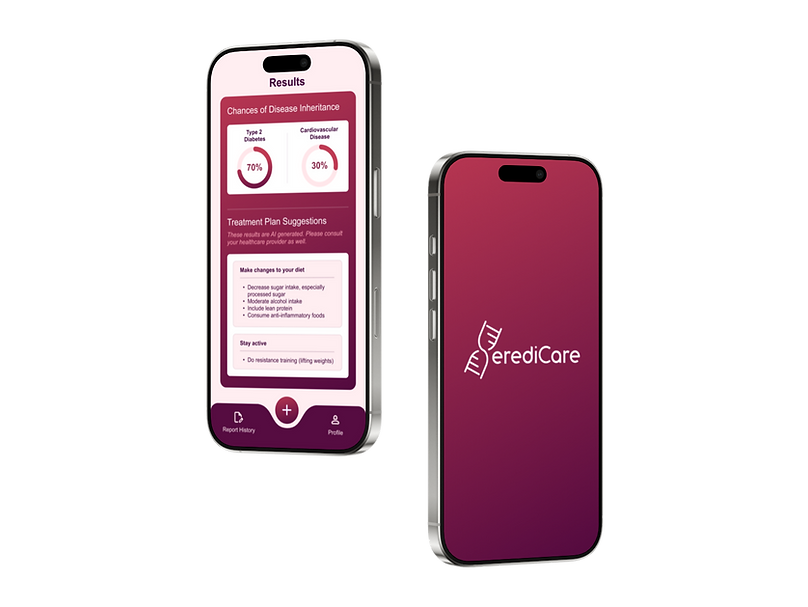
A B O U T H E R E D I C A R E
HerediCare is an AI-powered preventative healthcare app that assesses hereditary disease risks by analyzing a patient’s ancestry and medical history.
The platform provides personalized treatment plan recommendations to help users proactively manage disease progression and make informed healthcare decisions.
T H E P R O B L E M
While consulting for healthcare clients at IBM, I noticed how the complexity of medical information created a communication gap between patients and healthcare professionals.
leading to key pain points in the healthcare experience, including
P A I N P O I N T S I N H E A L T H C A R E
Late Diagnosis
Individuals getting diagnosed from diseases too late for treatment
Healthcare Inequity
Patients in rural areas struggling to access clear medical guidance due to limited availability of healthcare professionals
Diagnostic Tool Limitations
Current diagnostic tools unable to identify rare diseases
After researching and learning more about problems in healthcare, I found that most of them are related to diagnosis and one particular insight stood out to me -
Millions of people are affected by a genetic disease and more than 70% of them remain undiagnosed.
T H E S O L U T I O N
To address these challenges, I explored a few potential solutions.
P O T E N T I A L S O L U T I O N S & C O N C E P T S
Rare Disease Diagnostic Tool
Focuses on diagnosing rare diseases
Healthcare Administrative Tool
Helps handle logistical tasks such as scheduling, to allow time for more complex tasks
Preventative Healthcare Tool
Suggests a treatment plan for a disease a patient may have
To find the most effective solution, I evaluated each concept based on user needs, available resources, and overall feasibility.
Rare Disease Diagnostic Tool - Because rare diseases affect a small percentage of the population, developing a standalone product would not be the most efficient use of resources. Instead, a more scalable approach would be to expand existing diagnostic tools by integrating rare disease detection as an additional feature.
Healthcare Administrative Tool - This idea showed strong potential as administrative tasks like appointment scheduling, record-keeping, and insurance processing are common sources of inefficiency in healthcare. However, consolidating all these workflows into a single product could create an overly complex system. A more effective approach would be to focus on a specific process, requiring additional research and stakeholder interviews to clearly define the scope.
Preventative Healthcare Tool - This solution was inspired by a key user need identified during research: millions of people remain undiagnosed or unaware of potential conditions. The tool enables users to discover possible health risks and access actionable recommendations to better manage their wellbeing. While developing a solution that covers multiple conditions can be complex and data-intensive, its targeted scope makes it feasible while remaining flexible enough for future expansion. Compared to the other concepts, it offers the strongest balance of impact, feasibility, and alignment with user needs.
Since the preventative healthcare concept proved to be the most effective solution, I decided to create HerediCare,
an AI-powered app that analyzes a patient’s ancestry and health data to assess disease inheritance risk and provide personalized treatment recommendations.
S O L U T I O N D E V E L O P M E N T
I started to create the solution by mapping out the user flow, envisioning how users would naturally interact with the app to ensure a simple and intuitive experience.
U S E R F L O W

Building on the user flow, I created a sitemap to define the app’s information architecture and guide the design of its user interfaces.
S I T E M A P
.jpg)
I translated the sitemap into interfaces, helping users progress through the app intuitively.
A P P I N T E R F A C E S
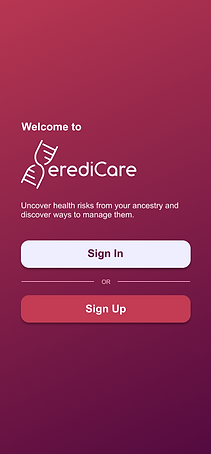

User has the option to create an account or sign in
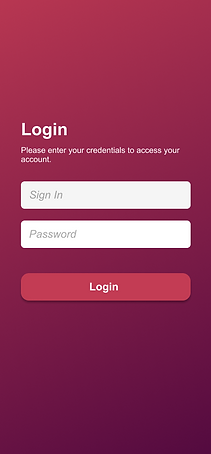
Let's say the user already has an account and selects sign in - they will be directed to a screen to enter their credentials
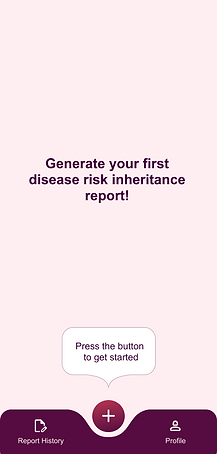
After logging in, the home page will appear where the user can press the "+" button to generate a disease inheritance risk report


To generate the report, the app needs the user's and their ancestor's medical report/history - they can upload new personal medical reports or choose a previously uploaded report
Once the user is done selecting the required materials, they can click generate to see potential diseases and a suggested treatment plan
To access/make any changes to the user's ancestor medical reports, users can refer to their profile
Alongside designing the user experience, I identified the AI technologies that power the app’s ability to predict disease inheritance risks and generate treatment plans.
A I T E C H S T A C K
Natural Language Processing
Analyzes patient and ancestral medical records
Predictive Analytics AI
Predicts disease inheritance risks using medical and ancestral data
Generative AI
Creates treatment plan suggestions using medical data and disease inheritance predictions
S I X M O N T H D E V E L O P M E N T P L A N
With the UX and AI foundation in place, I mapped out a six-month plan to take the product from concept to launch.
D E V E L O P M E N T P L A N
.png)
I M P A C T & P R O J E C T G O A L S
Lastly, beyond building the product, I defined measurable outcomes to see if the app improved healthcare affordability and disease management for users.
M E A S U R A B L E O U T C O M E S
Reduce the user's healthcare costs
This will be measured by conducting user surveys that asks users the amount of times they visited the doctor and the types of services performed.
Manage disease progression
This will be measured by conducting user surveys to understand previous and current pain levels. Another way will be comparing older personal medical reports to newer reports.